
Commercial Electronics Shipping from Dubai: Customs & Compliance Guide

Commercial electronics shipping from Dubai requires strict compliance with updated customs rules, accurate tariff classification, and mandatory product compliance standards. You also pay taxes on your shipment; the baseline customs duty for electronics is usually 5%, alongside a 5% VAT.
Commercial electronics shipping from Dubai is a great business opportunity, but also involves dealing with complex customs regulations. To get smartphones, laptops, and other items safely to your destination, you need a solid understanding of customs compliance. If you are shipping items that use lithium batteries, you must follow strict safety steps, or you have to face issues like delays or seized cargo at the border.
With clear customs planning, you can easily avoid fines and legal issues and keep your supply chain moving smoothly. Read this guide to know how you can protect your shipments, manage the paperwork, and clear customs without worries.
What Is Commercial Electronics Shipping from Dubai?
Shipping of commercial electronics from Dubai is the business of moving large quantities of electronic goods, like mobile phones, laptops, computer components, consumer appliances, and other tech parts from Dubai to other countries around the world. Business owners use its advanced air and sea freight networks to safely and quickly send bulk tech items to their global buyers. When moving wholesale or retail electronic goods, businesses need to meet UAE customs regulations and technology standards.
What Are Common Commercial Electronics?
Here are the common commercial electronics:

1. Enterprise & Office IT Hardware
- Computing Devices: Smartphones, tablets, or laptops.
- Networking Gear: Telecommunication routers, network switches, and servers
2. Retail & Point of Sale (POS) Equipment
- Transaction Tools: POS terminals, barcode scanners, and payment card readers.
- Commercial Displays: Projectors, flat-screen televisions, and digital signage boards used in stores.
3. Consumer Tech & Manufacturing Components
- Appliances: Home electronics, smart appliances, and professional audio systems.
- Core Components: Printed circuit boards (PCBs), semiconductors, and other tech components.
Commercial vs Personal Electronics Shipping in Dubai
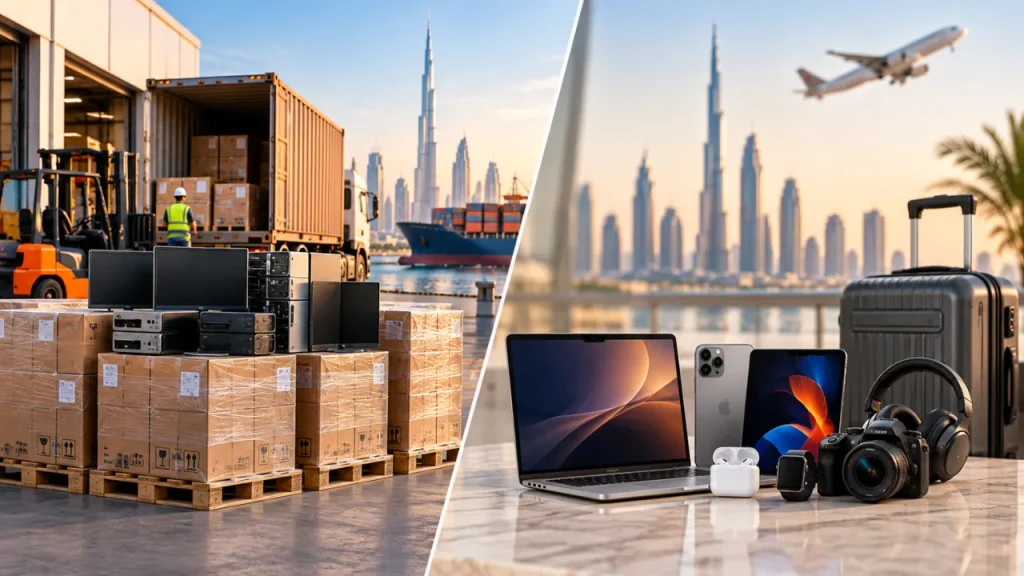
To ship electronics safely through Dubai, it is a must to understand whether your cargo falls under personal use or commercial trade. Dubai Customs applies entirely different regulations, duties, and paperwork requirements based on this classification.
| Feature | Commercial Electronics Shipping | Personal Electronics Shipping |
| Primary Purpose | Resale, business operations, or distribution. | Personal use, gifting, or household relocation. |
| Shipment Volume | Bulk quantities or mass inventory allowed. | Single units or a few items within reasonable personal limits. |
| Import/Export Code | Mandatory. Requires a valid Dubai Customs importer/exporter code. | Not Required. Can be cleared using an individual’s Emirates ID or Passport. |
| Duties & Taxes | 5% Customs Duty + 5% VAT applied to the total shipment value. | Exempt up to a certain threshold; standard duties/VAT apply if exceeded. |
| Special Permits | Often requires approvals from regulatory bodies like TDRA or MoIAT. | Generally not required unless importing restricted items in large quantities. |
| Documentation Needed | Commercial Invoice, Packing List, Certificate of Origin, Bill of Lading/Airway Bill. | Passport/Emirates ID copy, basic shipping label, purchase receipt, or proforma invoice. |
| Logistics Handling | Managed via commercial freight forwarders using Air or Sea Freight. | Handled by standard international couriers (like DHL, FedEx, or Aramex). |
What Makes an Electronics Shipment Commercial?
When you ship electronics safely from Dubai, you don’t have to worry about legal issues and costly penalties. Customs officers check what items you are shipping, why you are sending them, and other details. They look at specific factors like how many items you are sending, how much they are worth, and who is receiving them, to decide if your shipment is commercial.
- High Quantity of Items: Shipping large amounts of the exact same items is a huge sign for customs. If you are sending 50 identical laptops or smartphones in a single package, customs officers will know right away that you’re planning to resell them and that they are not for personal use.
- High Total Value: When the total value of the electronics crosses a specific limit. If you send electronics to Dubai that are more than AED 1,000, customs will label them as commercial goods. Even sending a few high-end items can easily exceed this duty-free limit.
- Intended for Resale: Brand new items that are sealed in original boxes or packaged with promotional materials look ready for resale. Customs classifies these items as commercial goods because they are clearly meant to be sold to customers.
- Business to Business (B2B): When you ship products from a registered company in Dubai to another company abroad, the shipment is treated as commercial. Because it is between two businesses, you can’t send it as a personal gift and ned to provide formal trade paperwork.
- Commercial Invoices Attached: Including a commercial invoice rather than a standard receipt shows that the shipments are commercial. This paperwork proves the items are part of a business deal and require official import duties and taxes.
How Dubai Customs Determines Commercial Electronics Shipments
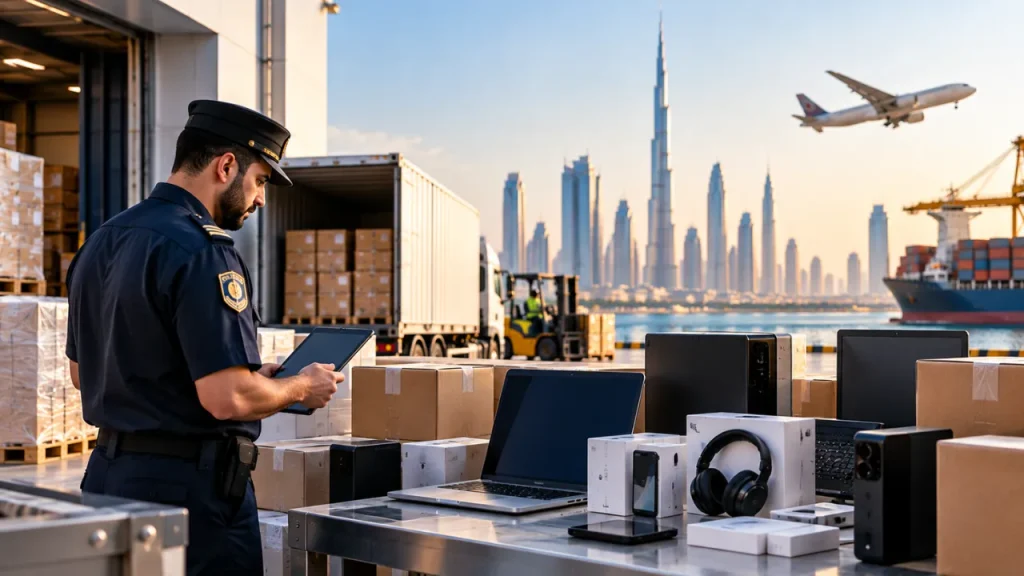
When you ship electronics into Dubai, customs officers use a highly organized system to review your cargo based on specific rules. They look at the paperwork, check the safety standards, and calculate taxes to make sure everything entering the country is safe. Whether you are involved in electronics shipping USA to UAE or any other route, you must know how customs determines commercial electronic shipments:
- The HS Code Classification: To import electronics to Dubai, you must use a specific 12-digit HS code. This code tells customs exactly what product you are shipping. It sets your tax rate and also shows whether you need extra safety certificates for your items.
- The Total CIF Value: Dubai Customs calculates your taxes and duties using the CIF value. This total adds up your product cost, shipping insurance, and freight fees. You pay 5% customs duty on most commercial electronics, and 5% VAT based on the total amount.
- Government Agency Approvals: When you ship electronic items with wireless features like Bluetooth or Wi-Fi, you must get special approval. Dubai Customs will check your paperwork to make sure you have TDRA approval.
- Risk-Based System Check: Dubai Customs uses an advanced digital system (Mirsal 2) to process your shipment. If your paperwork is completely correct and matches your cargo, your items pass through customs. But wrong details or missing documents can cause a delay for a physical inspection.
Customs Requirements for Commercial Electronics
Businesses must register with customs, declare what they are shipping, and provide the correct paperwork.
1. Mandatory Trade Documents
- Commercial Invoice: A bill from the seller that must clearly show the description of the electronics, the quantity, the price, and the correct 12-digit HS Codes.
- Detailed Packing List: This must show the exact contents, total weight, volume, and packaging type of the shipment.
- Certificate of Origin (COO): This document verifies the manufacturing country of the electronic items.
- Bill of Lading (Sea) or Airway Bill (Air): The transport document issued by the carrier serving as proof of cargo dispatch.
- Delivery Order: A document issued by the shipping line or agent to release the cargo for customs clearance.
2. Specialized Government Approvals (Mandatory for Tech)
- TDRA Customs Release Permit: This is mandatory for any device utilizing wireless tech like Wi-Fi and Bluetooth, such as smartphones, laptops, routers, and smart wearables.
- MoIAT ECAS Certification: Commercial electronics must comply with ECAS to ensure safety, quality, and low environmental hazard.
3. Other Documents
- Customs Registration: To export goods commercially, your business must have a valid trading license. Register your business with Dubai Customs to get a unique Customs Code.
- The Export Declaration: You must submit this document to tell customs exactly what you are shipping, how much it is worth, and where it is going.
- Lithium Battery Declaration: Devices like laptops, tablets, and smartphones contain lithium-ion batteries. Shippers need to provide a battery declaration and MSDS to comply with IATA and IMDG safety standards.
Note: Dubai customs requirements for commercial electronics can vary based on destination country, shipment type, and other factors. It is best to work with experts like S A G Logistic Services LLC, to easily handle these requirements.
Commercial Electronics Import vs Export from Dubai
The UAE is a major hub for commercial electronics trade. Importers mainly serve local businesses and retailers, while exporters target buyers in international and regional markets.
| Feature | Importing Electronics to Dubai | Exporting Electronics Out of Dubai |
| Primary Purpose | Bringing in electronics for final sale within the local UAE consumer or business market. | Moving electronics globally or re-exporting goods held in Dubai Free Zones to other countries. |
| Customs Duty | 5% Customs Duty assessed on the CIF value. | 0% customs duty, as exports are generally exempt from local trade taxes inside Dubai. |
| VAT / Taxes | 5% VAT is applicable on arrival. | 0% VAT in most cases. |
| Customs Declaration | Requires an Import Declaration through Dubai Customs. | Requires an Export Declaration through Dubai Customs. |
| Regulatory Approvals | May require TDRA approval, customs clearance permits, and MoIAT ECAS quality certificates. | Generally exempt from local UAE tech approvals if products meet destination country rules. |
| Key Documentation | Commercial invoice, packing list, Airway Bill or Bill of Lading, Delivery order, and import declaration. | Commercial invoice, packing list, certificate of origin, and export declaration. |
| Free Zone Treatment | Direct imports into Free Zones may be duty- and VAT-exempt while goods stay in the zone. | Direct exports from Free Zones can move to international markets without customs duties. |
| Target Market | UAE retailers, businesses, and regional distributors. | International buyers and regional markets. |
Costs Involved in Commercial Electronics Shipping
Commercial electronics shipping from Dubai involves more than transport charges. You have to pay for taxes, insurance, compliance fees, and other costs that are:
- Base Freight & Weight: This cost is calculated by your carrier based on how much your cargo weighs and the space it takes up (its volume). As electronic items are usually heavy or bulky, you need to plan a major part of your shipping budget for these charges.
- Special Packaging: To ship electronics safely, you need to pay for high-quality protective packaging like anti-static wraps, padded boxes, and custom foam inserts to make sure your goods arrive safely. You also have to pay labor and material costs.
- Insurance & Liability Protection: If your shipment gets damaged, lost, or stolen, the standard coverage from shipping companies usually is not enough. You need to pay for cargo insurance to protect your high-value electronic items.
- Subcharges & Handling: These are extra charges added by your carrier, like fuel surcharges, remote delivery fees, and others.
- Customs & Duties: 5% customs duty and 5% VAT are applied to the CIF value, with customs broker clearance fees. Moreover, when your goods reach the destination country, you have to pay tariffs, local taxes, and other government charges.
- Government & Compliance Fees: You will have to pay for official certificates, quality checks, and paperwork to prove your products are safe and legal to sell.
- Port & Terminal Handling Charges: These are the fees charged by the airports or seaports in both Dubai and your destination. They cover the cost of using the cranes, forklifts, and labor needed to load and unload your cargo.
Note: You should discuss the total costs involved in commercial electronics shipping from Dubai for your shipments with S A G Logistic Services LLC to avoid any sudden financial burden later.
Common Customs Problems With Commercial Electronics
Here are the 6 common customs problems that businesses usually face with commercial electronics:
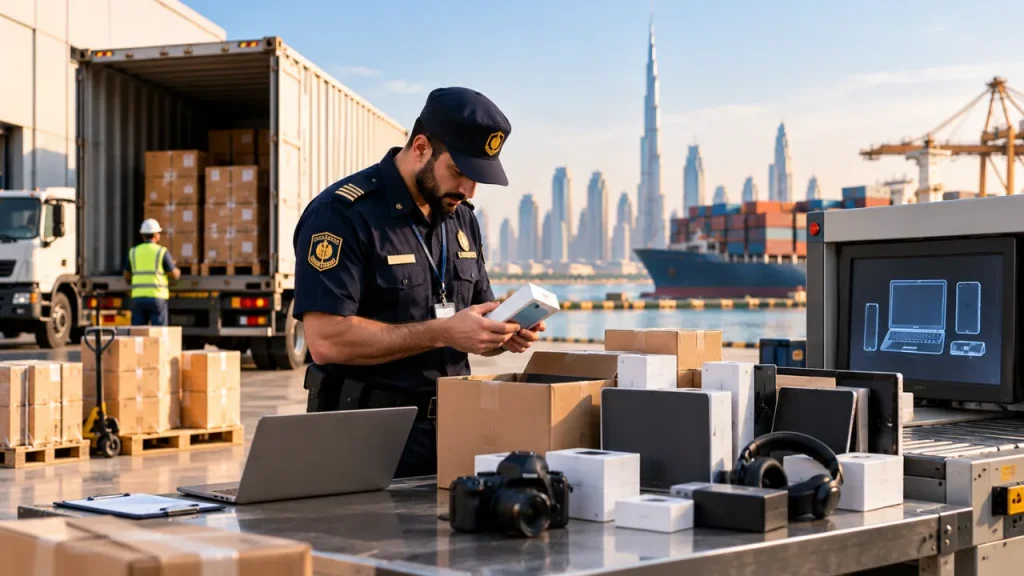
- Wrong or Outdated HS Codes: If you use old or wrong HS codes, customs officers will consider it a major offense. Your cargo can be put on hold. You must use the correct code and pay the duty rate to avoid fines for filing wrong paperwork.
- Missing TDRA Permits: If your shipment arrives at the port without a valid TDRA Customs Release Permit, it will not be allowed to enter. You must secure it before, or otherwise your cargo will face an automatic hold.
- Invoice Value Mismatches: Dubai Customs checks your commercial invoice against your customs declaration. If the prices don’t match perfectly, they can pause the clearance process to investigate whether you are trying to hide the true value to pay less tax.
- Unclear Goods Description: Using vague phrases like “electronics,” “computer parts,” or “accessories” on your documents is a major customs problem. You need to provide detailed descriptions of what is inside your cargo. This problem can lead to a manual physical inspection that causes delays and costs extra service fees.
- Missing or Incomplete Certificate of Origin: If you don’t provide this document or fill it out incorrectly, customs will block your shipment or force you to pay the highest possible standard duty rate until you can prove where the goods came from.
- Lack of Lithium Battery Safety Data (MSDS): Most modern electronics use lithium-ion batteries, which are legally classified as dangerous goods due to fire risks. If you fail to include an MSDS or the correct battery warning labels, airlines or shipping lines will refuse to release the cargo at the port.
When Do You Need IOR or EOR for Commercial Electronics?
You need IOR or EOR for commercial electronics when you ship them across borders and don’t have a local office in that country, or if the shipping rules are too complex to handle without expert help.
When You Need an Importer of Record (IOR)
An IOR takes legal and financial responsibility for goods entering a destination country. You need an IOR when:
- No Local Presence: If your company has no physical or local business office in the destination country to clear customs.
- Strict Tech Regulations: You also need an IOR if the commercial electronics have strict safety rules that require local approval before entry.
- Controlled or Dual-Use Hardware: If the items contain encryption or special telecom parts, you need a trusted IOR service provider to handle the import permits.
- Delivered Duty Paid (DDP) Shipping: You agree to cover all import duties, local taxes (like GST/VAT), and clearance fees without placing the burden on your overseas buyer.
When You Need an Exporter of Record (EOR)
An EOR ensures compliance and manages legal rules for goods leaving the origin country. You need an EOR when:
- Export Licensing Constraints: You must work with an EOR if the origin country has strict rules on sending out high-tech or encrypted electronics.
- Lacking Export Authority: If your business doesn’t have the required licenses, export registration, or local tax identification to legally ship out of the manufacturing country.
- Managing Outbound Audits: You need an EOR to help you file formal export declarations and follow international trade laws as the goods leave.
Why Choose S A G Logistic Services LLC?
You can easily handle commercial electronics shipping from Dubai with an expert logistics partner who provides custom solutions and understands compliance laws of the UAE and global markets. S A G Logistic Services LLC is a top-rated logistics company in Dubai.
- Years of Industry Expertise: We have years of experience in handling commercial electronics shipping from the UAE to global markets for various clients. We know how to bypass common delays and keep your supply chain moving smoothly.
- End-to-End IOR & EOR Solutions: We offer custom IOR, EOR, and DDP services. Our team handles the legal paperwork, pays import duties, and manages customs clearance so you do not have to set up costly legal representation abroad.
- Specialized Electronics Handling: We provide special packaging, secure warehousing, and transport management for delicate and high-value electronic items. We are a trusted partner for many top leaders in the industry.
- Customs Clearance Support: When you choose our team for electronics shipping USA to UAE, UAE to the USA, or to any other global destination, we manage customs documents, declarations, and clearance requirements for your electronics shipments.
- Flexible Freight Options: We provide air, ocean, road, and warehousing solutions based on your shipment size, destination, and delivery needs. First, we understand your needs and then offer a solution that matches them perfectly.
Connect with S A G Logistic Services LLC to get expert support for proper planning and customs compliance for moving your commercial electronics from Dubai. Share your details to get special customs clearance, IOR/EOR, and other logistics support.
Frequently Asked Questions (FAQs)
1. What is commercial electronics shipping from Dubai?
It means shipping electronic goods in bulk for business, resale, or distribution. This can include laptops, smartphones, servers, routers, and other equipment.
2. What documents are needed to ship electronics from Dubai?
Common documents include a commercial invoice, packing list, certificate of origin, and airway bill or bill of lading.
3. Do electronics need special approvals in Dubai?
Some electronics may need regulatory approvals before customs clearance. Wireless devices may require TDRA-related approvals.
4. What is an IOR for electronics shipping?
An Importer of Record (IOR) handles import responsibilities in the destination country. This includes customs paperwork, duties, and compliance requirements.
5. When do I need an EOR for electronics?
An Exporter of Record (EOR) helps manage export documentation and compliance when your goods are shipped across borders.