
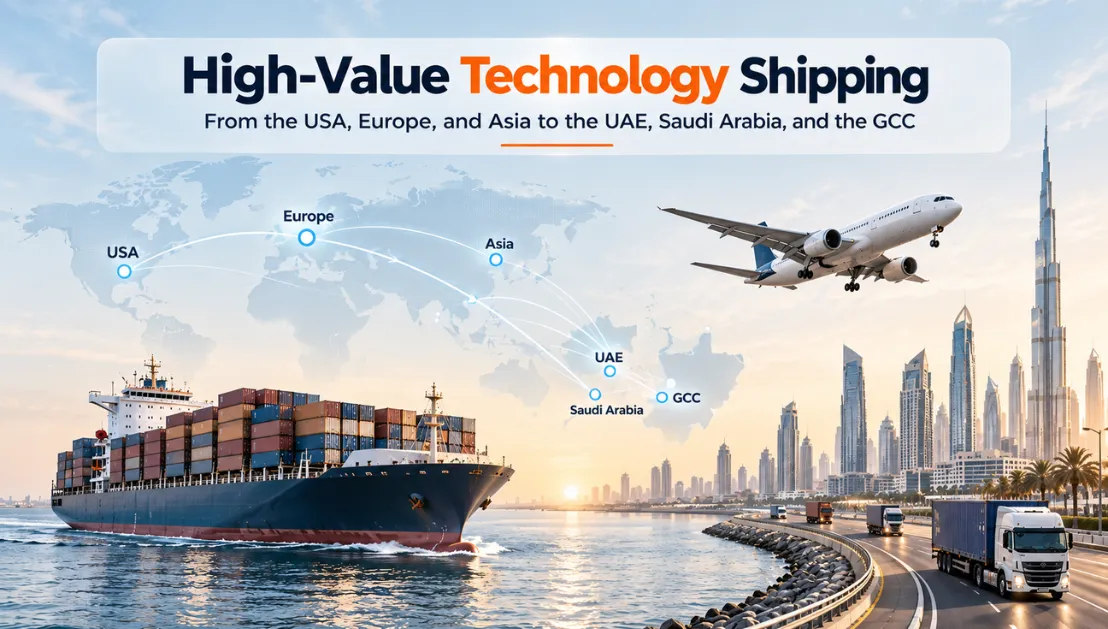
High-Value Technology Shipping From the USA, Europe, and Asia to the UAE, Saudi Arabia, and the GCC

Under the guidance of Sikandar Sinha, 25+ Years in International Logistics and Trade compliance.
Quick Summary: SAG Logistics provides end-to-end shipping solutions for high-value technology from the USA, Europe, and Asia to the GCC. It handles EOR, IOR, customs clearance, DDP, compliance, warehousing, freight, and white-glove delivery, ensuring all required documentation, certifications, duties, and approvals are managed for smooth and secure delivery.
What does a seamless high-value technology shipment to the GCC require?
Every high-value technology shipment that arrives on time and clears without query or delay has one thing in common: classification, licensing, valuation, and handling decisions were made correctly before the cargo made a move.
High-value technology does not just require simple freight, but more than that. Several essential items, such as laptops, smartphones, servers, networking hardware, AR/VR headsets, and robotics, carry serial-level traceability, type approval obligations, export control screening, and lithium battery rules, which call for specialised handling from the very start to the end. Each of these high-value & critical technology items must align with the import regime of the destination country, and each has to be settled in advance to ensure that there are no delays.
As one of the leading IOR/EOR/DDP service providers, S A G Logistic Services LLC (S A G Logistics) is built around that principle. From its operational base in Dubai, SAG connects technology shipments from the USA, Europe, and Asia to the UAE, Saudi Arabia, and every GCC market as a trusted single point of accountability. Thus, we ensure that there are no delays.
Our Range of Services

At S A G Logistic Services LLC, we offer expertise in IOR, customs compliance & DDP services from the USA to Dubai, Saudi Arabia, and other GCC regions. Here is a closer look at what we offer:
- Exporter of Record (EOR): SAG prepares export paperwork and files export declarations at origin on the shipper’s behalf.
- Importer of Record (IOR): Companies without a GCC entity, or whose Trade Licence does not yet include import activity, can import lawfully with SAG taking legal responsibility for the import, duties and taxes.
- Freight Services: We also assist with air and sea freight at competitive rates with major airlines and shipping lines.
- Customs Compliance & DDP: One of our key services is customs clearance and compliance & DDP from the USA, Europe, and Asia to the UAE, Saudi Arabia, and the GCC.
We take care of the HS classification, customs valuation, type approvals, conformity certificates, and duty and VAT settlement, delivered on Delivered Duty Paid terms so the consignee receives goods with every cost already cleared.
- White Glove Delivery: We execute careful final-mile delivery to the consignee’s site, with unpacking, positioning, and signed proof of delivery.
- Warehousing & Distribution: We are also experts in warehousing and 3PL capabilities with onward distribution across the GCC, supported by value-added services including Trust Account, Fund Transfer, Transfer of Ownership, Transit In and Out, Export Paperwork, Import Paperwork, and Dead Stock Transfer.
What rules apply to technology shipped from the USA to the GCC?
The United States is a major source of enterprise IT, cloud infrastructure, and premium consumer devices for the Gulf. Air freight moves through New York (JFK), Los Angeles (LAX), Chicago (ORD), Dallas Fort Worth (DFW), Miami (MIA) and San Francisco (SFO), while sea freight departs from the Port of New York and New Jersey (USNYC), Port of Los Angeles (USLAX), Port of Savannah (USSAV) and Port of Houston (USHOU).
US exports of technology are governed by the Export Administration Regulations (EAR). Each item carries an Export Control Classification Number (ECCN) or the EAR99 designation, and encryption-capable devices are reviewed under the relevant encryption provisions. Export data is filed as Electronic Export Information (EEI) through the Automated Export System (AES) where required, referencing the Schedule B number of each product.
Thus, with an understanding of IOR, EOR, and DDP Services from the USA to the Middle East, the team at S A G Logistic Services LLC can execute shipments carefully, safely, and lawfully.
What rules apply to technology shipped from Europe to the GCC?

Europe supplies high-specification computing, industrial automation, robotics, professional audio-visual systems, and telecom infrastructure. Principal gateways include Frankfurt Airport (FRA), Amsterdam Schiphol Airport (AMS), London Heathrow Airport (LHR), Paris Charles de Gaulle Airport (CDG) and Liège Airport (LGG), together with the Port of Rotterdam (NLRTM), Port of Antwerp-Bruges (BEANR) and Port of Hamburg (DEHAM).
Shipments originate across Germany, France, Italy, the Netherlands, Belgium, Spain, Ireland, Switzerland and the United Kingdom, as well as the Nordic countries of Sweden, Denmark, Finland, Norway and Iceland. Within the EU, export declarations are lodged electronically and receive a Movement Reference Number (MRN), while controlled items are assessed under the EU Dual-Use Regulation (EU) 2021/821. The UK, Switzerland and Norway operate their own export declaration and strategic control systems that mirror this discipline.
What rules apply to technology shipped from Asia to the GCC?

Asia is a principal manufacturing base for global technology. Air cargo moves through Hong Kong (HKG), Singapore Changi (SIN), Shanghai Pudong (PVG), Shenzhen (SZX), Seoul Incheon (ICN), Taipei Taoyuan (TPE), Tokyo Narita (NRT), Mumbai (BOM), Delhi (DEL) and Bengaluru (BLR). Ocean cargo departs from the Port of Shanghai (CNSHA), Port of Yantian (CNYTN), Port of Hong Kong (HKHKG), Port of Singapore (SGSIN), Port of Busan (KRPUS) and Jawaharlal Nehru Port, Nhava Sheva (INNSA).
Each origin applies its own export framework. Hong Kong uses its Strategic Commodities Control System and electronic trade declarations, Singapore issues permits through TradeNet under its Strategic Goods (Control) Act, China files declarations through the China International Trade Single Window, and India requires a Shipping Bill on ICEGATE together with the exporter’s Importer Exporter Code (IEC).
How S A G Logistic Services LLC brings it together
Across all three continents, S A G Logistic Services LLC manages the shipment as one continuous chain rather than a series of hand-offs. SAG arranges all paperwork at origin and destination, files export declarations as Exporter of Record (EOR), books air or sea freight, and routes every consignment through Dubai. On arrival, SAG clears the goods as Importer of Record (IOR) or on the client’s own licence, settles duty and VAT on DDP terms, and completes white-glove delivery to the final site anywhere in the GCC.
Thus, we assist in the shipment journey with our efficient high-value equipment IOR, Customs Compliance & DDP Services from the USA to Dubai, Saudi Arabia, and the Middle East.
What customs and compliance terms do you need to know when shipping technology to the GCC?
Take a look at the customs and compliance terms you need to know when shipping technology to the GCC.
| Term | What it means for technology shipments |
| HS code | The Harmonized System classification that determines duty rates, permits, and type approval needs. Accurate classification at the national GCC tariff line is the foundation of every clearance. |
| Customs valuation | GCC customs assess duty on the CIF value (cost, insurance, and freight) using the WTO transaction value method. Free-of-charge and replacement units are declared at fair market value. |
| Customs duty | Set under the GCC Common Customs Tariff, with a standard rate of 5% of CIF value. The exact rate for each product is confirmed by its HS code and the national tariff of the destination country. |
| VAT | UAE 5%, Saudi Arabia 15%, Bahrain 10% and Oman 5%. Qatar and Kuwait currently apply no VAT. |
| Trade Licence (TL) | The UAE commercial licence of the importer. It must include import activity for goods to be cleared under the client’s name. |
| VAT Certificate (TRN) | The UAE Tax Registration Number, essential for VAT accounting and recovery on every import. |
| Mirsal | Dubai Customs’ electronic declaration system (Mirsal 2), through which every Dubai import declaration is lodged and released. |
| MoFA attestation | Attestation of incoming commercial invoices by the UAE Ministry of Foreign Affairs, applied according to current requirements. |
| Original documents deposit | Where original documents are not yet available, a refundable customs deposit of AED 1,060 per shipment secures release. |
| TDRA type approval | Mandatory UAE approval for any device with wireless, cellular, Bluetooth or Wi-Fi capability. |
| Commercial Registration (CR) | The Saudi company registration that must carry out import activity for goods to be cleared under the consignee’s name. |
| SABER | Saudi Arabia’s conformity platform, issuing the Product Certificate of Conformity (PCoC) and the Shipment Certificate of Conformity (SCoC) for regulated products. |
| CST type approval | Approval from Saudi Arabia’s Communications, Space and Technology Commission for wireless and telecom equipment. |
| FASAH | The ZATCA electronic platform through which Saudi import declarations are processed. |
| GCC type approval bodies | CRA in Qatar, CITRA in Kuwait, TRA in Oman and TRA in Bahrain, each approving wireless and telecom devices for its market. |
| UN38.3 and SDS | Test summary and safety data sheet required for lithium-ion batteries, packed and declared under IATA Packing Instructions 965 to 970. |
| ECCN and EAR99 | US export control classifications identifying whether an item needs a licence or licence exception before export. |
| Free zone status | Goods entering a designated free zone such as JAFZA, DAFZA or Dubai South are held duty-free until released into the local market. |
Which Industries Does S A G Logistics Support For High Value Shipment?

For our comprehensive IOR, EOR, DDP Services from Europe, Asia, USA to the GCC, we cater to a range of sectors. These include:
- Technology: Smartphones, tablets, laptops and wearables from brands such as Apple, Samsung, Dell, HP and Lenovo, together with AR/VR headsets, gaming systems, drones, robotics and battery-powered devices.
- Enterprise IT: Servers, storage arrays, networking switches, firewalls, GPU clusters and complete data centre deployments for hyperscale, colocation and corporate projects.
- Luxury: Designer homeware, premium audio-visual systems, high-end retail fixtures and luxury lifestyle goods.
- Fine Art: Paintings, sculpture and installation works.
- FF&E: Furniture, fixtures and equipment for hotels, residences, offices and retail fit-outs, including bespoke joinery, designer lighting, smart room controls, in-room technology and the integrated systems that bring a completed space to life.
- Other Industries: Industrial automation, telecom infrastructure, broadcast and professional audio-visual equipment, automotive technology, energy and solar equipment, aviation ground support, education technology and e-commerce.
- Cosmetics and Branded FMCG Packed Food and Hygiene Products: SAG clears these compliantly by securing product registration before shipment, through Dubai Municipality’s Montaji platform in the UAE and the Saudi Food and Drug Authority (SFDA) in Saudi Arabia, with Arabic-compliant labelling, ingredient declarations, health certificates and certificates of origin aligned to each GCC market.
- Marketplace Sellers: SAG holds formal relations with Amazon and Noon, supporting sellers who move inventory into these marketplaces.
Arriving in the GCC
SAG’s arrival network is anchored in Dubai. Dubai International Airport (DXB) is the principal air gateway, with Abu Dhabi International Airport (AUH) as a strong alternative. Jebel Ali Port (AEJEA) and Khor Fakkan Port (AEKLF) are SAG’s major sea gateways, supported by Sohar Port (OMSOH) in Oman. These routes keep cargo moving reliably to every GCC market.
From Dubai, consignments continue by secured trucks to Saudi Arabia, Qatar, Kuwait, Oman and Bahrain, or by onward air and sea links to King Khalid International Airport, Riyadh (RUH), King Abdulaziz International Airport, Jeddah (JED), King Fahd International Airport, Dammam (DMM), Hamad International Airport, Doha (DOH), Kuwait International Airport (KWI), Muscat International Airport (MCT) and Bahrain International Airport (BAH), as well as Jeddah Islamic Port (SAJED), King Abdulaziz Port, Dammam (SADMM), Hamad Port (QAHMD), Shuwaikh Port (KWSWK) and Khalifa Bin Salman Port (BHKBS).
- United Arab Emirates. Trade Licence (TL) and VAT Certificate (TRN) are the keys to every clearance. The licence must include import activity, the importer must hold a customs client code, and wireless devices require TDRA type approval. Declarations are lodged through Mirsal, with MoFA attestation of invoices applied as required.
- Saudi Arabia. A Commercial Registration (CR) with import activity, customs registration on FASAH, SABER PCoC and SCoC certificates and CST type approval for wireless devices ensure swift release. Arabic labelling and SASO technical regulations apply to consumer electronics.
- Qatar, Kuwait, Oman and Bahrain. Each market applies the GCC Common Customs Tariff with its own importer registration, national customs platform and telecom type approval, which SAG secures ahead of dispatch so the truck crosses each border without delay.
Incoterms for technology shipments
- DDP (Delivered Duty Paid). The seller, through SAG, delivers cleared, duty- and VAT-paid goods to the consignee’s door.
- EXW (Ex Works). SAG collects from the supplier’s premises and manages every step thereafter.
- DAP (Delivered at Place). Goods are delivered to the named place, with import clearance arranged by the buyer or by SAG as IOR.
- FCA and CIP. Used where the seller hands over to the carrier at origin, with CIP adding insurance cover.
How SAG Guarantees a Smooth Shipment Journey
Take a closer look at how SAG eases out the overall IOR, EOR, and DDP solutions for customers:
| What SAG secures | How it is achieved |
| Perfectly matched documents | Invoice, packing list, serial numbers and certificates of origin cross-checked line by line before dispatch. |
| Correct classification | HS codes, ECCNs and national tariff lines confirmed for every SKU. |
| Complete certification | TDRA, CST, SABER and GCC type approvals in place before the cargo moves. |
| Battery readiness | UN38.3 test summaries, SDS and IATA-compliant packing for every lithium-ion product. |
| Accurate valuation | CIF value declared correctly, including free-of-charge and replacement units. |
| Cargo in pristine condition | Specialised handling from collection to delivery, with secured trucks across the GCC. |
| A flawless handover | White-glove delivery with unpacking, positioning and signed proof of delivery. |
How SAG Executes Every High-Value Shipment
SAG follows a comprehensive, well-structured procedure when it comes to high-value shipments from Europe, USA, and Asia to GCC regions. Take a look:
Step 1: Export From the Origin
SAG collects from the supplier, verifies the cargo against the documents, and files the export declaration as Exporter of Record (EOR).
Step 2: Import in the UAE, Saudi Arabia or the Wider GCC
The consignment arrives through DXB, Jebel Ali, or Khor Fakkan and is declared under SAG’s Importer of Record (IOR) or the client’s licence.
Step 3: Customs Compliance and Clearance
Duty and VAT are settled on DDP terms, conformity and type approval certificates are presented, and the goods are released.
Step 4: White Glove Delivery
Secured trucks carry the shipment to its final address, where the SAG team unpacks, positions, and hands over the equipment.
How does S A G Logistics safeguard high-value technology shipments?
At S A G Logistics, we make sure that our DDP, customs compliance, and EOR services protect your shipment from start to end. Here is what we ensure:
- Documentation and compliance come first: SAG reviews every document before accepting a shipment and does not accept a shipment with even a 0.01% error in its paperwork. Every licence, certificate and declaration is prepared and checked at both origin and destination before the cargo moves.
- This discipline is the source of SAG’s proudest commitment: Because every requirement is secured before dispatch, SAG delivers with 100% certainty from collection in the USA, Europe or Asia to final placement in the GCC.
- Clearance without a licence change. If a client’s Trade Licence does not include import activity, SAG simply acts as Importer of Record (IOR), so the shipment clears smoothly and the client receives the goods without amending its licence.
- Clear responsibility for port charges. Under SAG’s IOR, SAG takes responsibility for demurrage and storage. Where a shipment is imported under the client’s own IOR, the client covers storage, demurrage and detention at airports and seaports, and SAG’s pre-checked documents keep those charges to a minimum.
Who we serve
- Global technology brands entering the GCC without a local entity.
- System integrators and data centre operators delivering enterprise IT projects.
- Distributors, resellers and marketplace sellers on Amazon and Noon.
- Hotel, residential and corporate fit-out teams sourcing FF&E and in-room technology.
- Multinationals relocating or refreshing high-value assets across the region.
Frequently Asked Questions (FAQs)
1. Why do high-value technology consignments need specialised handling rather than standard freight?
High-value technology carries serial-level traceability, type approval, export control and valuation obligations that standard freight does not address. Each consignment needs matched documents, secured custody and pre-cleared certification from origin to installation, which is the end-to-end discipline SAG applies to every shipment.
2. What is an Importer of Record (IOR) and when do I need one for a high-value import into the GCC?
An Importer of Record (IOR) is the legal entity responsible for the import, including declarations, duties, taxes, and compliance. You need one when your company has no GCC entity, or when your Trade Licence or Commercial Registration does not include import activity. SAG acts as IOR across the UAE, Saudi Arabia, Qatar, Kuwait, Oman, and Bahrain, so high-value consignments clear smoothly in every market.
3. Why does Commercial Registration (CR) matter for high-value imports into Saudi Arabia?
Saudi customs clears goods only for a consignee whose CR includes import activity and who is registered on FASAH. For high-value enterprise IT and devices, the CR must also align with the SABER and CST certificates issued for the products. Where a CR lacks import activity, SAG imports the goods as IOR.
4. Why are the Trade Licence (TL) and TRN critical for high-value imports into the UAE?
The Trade Licence must list import activity for Dubai Customs to clear goods in your name, and the TRN ensures the 5% import VAT on a high-value consignment is accounted for and recovered correctly. Both are verified on every declaration.
5. How is customs value calculated on a high-value technology consignment?
GCC customs assess value on a CIF basis using the WTO transaction value method. The invoice value, international freight, and insurance are combined, and duty and VAT are calculated on that total. Because the sums involved are significant, every element of the CIF build-up is documented and reconciled before filing.
6. Which technology products need TDRA type approval in the UAE?
Any device with wireless, cellular, Bluetooth, or Wi-Fi capability, including smartphones, laptops, routers, smart speakers, AR/VR headsets, and IoT devices, requires TDRA type approval before import. For high-value rollouts, approval is secured per model before the first unit ships.
7. What are SABER PCoC and SCoC, and how do they apply to split shipments?
The Product Certificate of Conformity (PCoC) covers the product model, while a Shipment Certificate of Conformity (SCoC) is issued for each consignment. When a large order is split across several flights or containers, each part needs its own SCoC, invoice, and packing list.
8. How are dual-use items handled when shipping from Europe?
Items listed under the EU Dual-Use Regulation (EU) 2021/821 need an export authorisation from the relevant member state. SAG verifies each product’s status before the export declaration, and MRNs are issued.
9. Which Incoterm best protects a high-value technology shipment to the GCC?
DDP gives the consignee the most controlled experience, with clearance, duty, VAT and delivery managed by one party. EXW suits buyers who want SAG to take custody from the supplier’s door, and DAP works where the buyer manages import formalities or appoints SAG as IOR.
10. Can SAG handle high-value technology shipments from the USA, Europe, or Asia to multiple GCC countries?
Yes. SAG can coordinate high-value technology shipments from the USA, Europe, and Asia to the UAE, Saudi Arabia, Qatar, Kuwait, Oman, and Bahrain. Depending on the destination and shipment requirements, SAG can manage EOR, IOR, customs clearance, DDP, warehousing, and white-glove delivery as part of an end-to-end logistics solution.
Move your high-value technology with certainty through S A G Logistics.
High-value technology deserves a partner that treats every serial number, certificate, and declaration as critical. S A G Logistic Services LLC (S A G Logistics) combines 25+ years of experience, a network across 120+ countries, and deep GCC compliance expertise to move your consignments from the USA, Europe, and Asia to the UAE, Saudi Arabia, and the wider GCC. Never a stuck shipment. Contact SAG today to plan your next high-value technology consignment.
Also Read: 5 Reasons Businesses Choose Monthly Storage in Sharjah for Inventory