
10 Common Air Freight Mistakes and How to Avoid Them

Air freight is the quickest and most protective way to move time-sensitive or high-value cargo, but it is also remarkably more costly than other shipping methods. To make sure your shipment comes out protective and affordable, it is crucial to sidestep 10 common pitfalls.
When your company requires you to move goods across borders rapidly, air freight is the ideal solution. It sidesteps weeks of ocean transit, makes sure tight inventory control, and securely delivers high-value products to global markets.
However, because air cargo moves at lightning speed, any air freight mistakes can lead to primary disruptions. A small documentation typo or a wrong weight estimation can immediately halt your shipment at the airport, transforming an express delivery into a costly logistical nightmare. In international aviation centers like Dubai, where customs processing is extremely automated and stringently regulated, handling adherence demands absolute accuracy.
List of the Air Freight Mistakes and Solutions
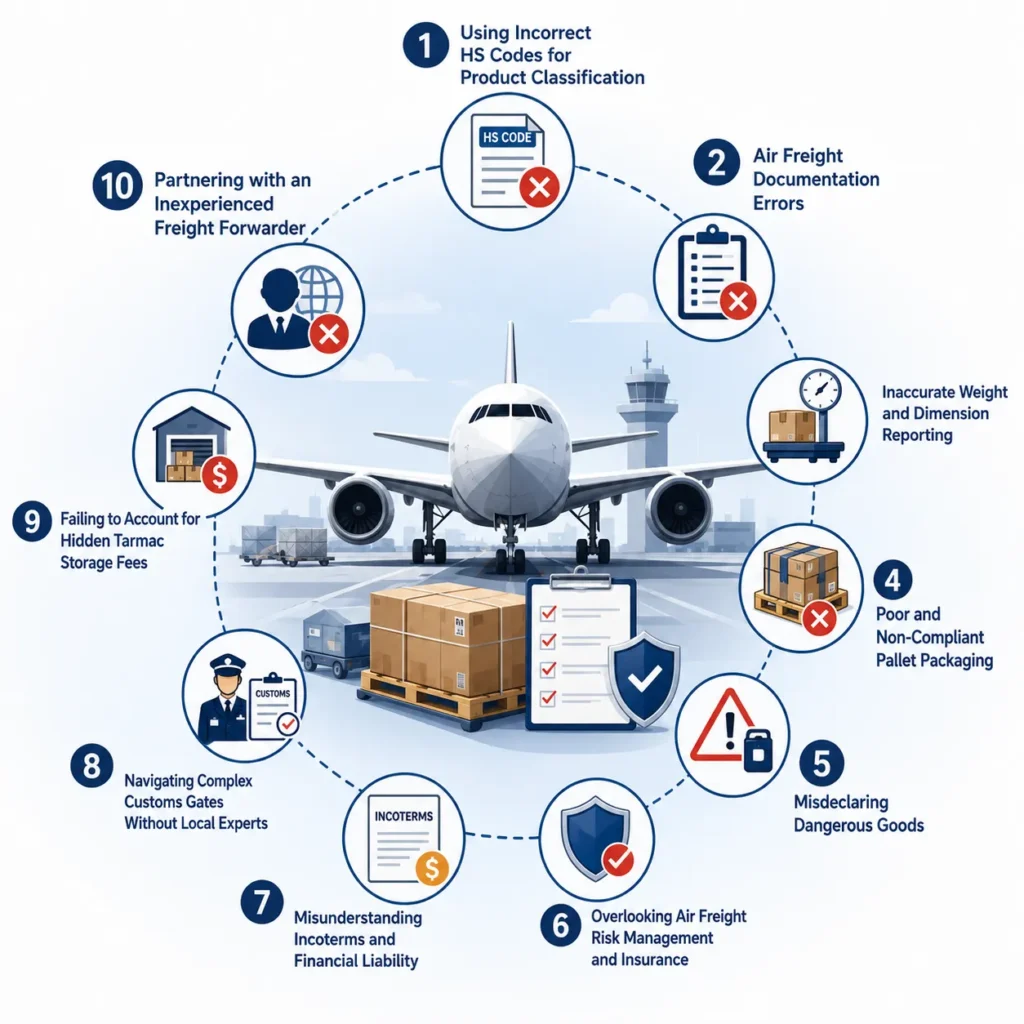
1. Using Incorrect HS Codes for Product Classification
Every product shipped globally should be assigned a Harmonized System code. This universal code tells customs officers precisely what your cargo is, which determines the duties and taxes you are liable for.
A typical air freight shipping mistake is utilizing generic or outdated HS Codes to speed through booking. Under the updated UAE import regulations, customs authorities transitioned to an incorporated tariff system that mandates extremely particular product coding. Presenting a wrong or truncated code can lead to cargo detention, complete manual verifications, and severe management penalties.
- How to Avoid it – Work closely with seasoned clearance experts who cross-reference international tariff databases to examine your precise product codes prior to booking flight space.
2. Air Freight Documentation Errors
A single mismatched letter or missing signature on your documentation can instantly ground your air cargo. Crucial documentation, like the Air Waybill, Commercial Invoice, Packing List, and Certificate of Origin, should ideally align.
Typical air freight documentation errors include mismatching total piece counts between the invoice and the AWB, omitting thorough descriptions, or listing wrong consignee addresses.
- Important UAE Update – Dubai Customs stringently demands modern technical declaration filing through the Dubai Trade portal. Mistakes on these technical filings now incur penalties, though some early submission corrections may be eligible for penalty waivers if updated before arrival.
3. Inaccurate Weight and Dimension Reporting
Airplanes have stringent space limits and rigid weight thresholds. Air freight pricing is calculated utilizing a metric called chargeable weight, which is determined by comparing the actual gross weight of the cargo against its volumetric size.
If your group delivers inaccurate measurements to save time, the airline will re-measure the pallet at the cargo terminal. If the shipment is bigger or heavier than declared, you face instant rate adjustments, probable bumping to a later flight, and unwanted management costs.
4. Poor and Non-Compliant Pallet Packaging
Air cargo goes through intense kinetic forces during take-off, turbulence, and landing. Packing goods in common retail cardboard boxes without industrial reinforcement is a recipe for structural failure.
Worse yet, utilizing uncertified wooden pallets that violate global phytosanitary standards will cause air cargo customs clearance agents to reject the whole shipment.
- How to Avoid it – Always utilize high-grade, double-walled corrugated boxes, protect internal cushioning, and heat-treated or plastic pallets certified for global air travel.
5. Misdeclaring Dangerous Goods
A number of everyday products are categorized as Dangerous Goods under International Air Transport Association policies. This comprises lithium-ion batteries, perfumes, aerosol cans, aerosols, and some chemical compounds.
Failing to declare these products completely is a crucial safety risk and a serious regulatory violation. Unlabeled risky materials will be intercepted by airport protection screening, leading to blacklisting, heavy penalties, and potential legal prosecution.
6. Overlooking Air Freight Risk Management and Insurance
Because air shipping is highly quick, several business owners mistakenly assume that cargo insurance is unnecessary. This is a risky gap in air freight risk management.
Airports manage millions of tons of cargo regularly. They can also be dropped by forklifts, rained on the tarmac, or simply lost in transshipment. Under normal international aviation treaties, airlines have limited liability for lost or damaged cargo, and they only pay a low, fixed amount per kilogram, regardless of the cash value of your luxury electronics or costly medical tools.
7. Misunderstanding Incoterms and Financial Liability
Incoterms describe precisely when financial risk and transportation expenses shift from the seller to the buyer. Selecting the wrong income on your trade contract can force your company to cover unwanted airport management costs, terminal storage charges, or local customs import duties that you didn’t budget for.
- The Lesson – Never sign a commercial shipping invoice until you comprehend who is paying for the airport loading, the global flight, and the final delivery leg.
8. Navigating Complex Customs Gates Without Local Experts
Attempting to handle air cargo customs clearance UAE protocols without boots-on-the-ground representation is a typical root cause of cargo gridlock.
To clear cargo seamlessly at locations like Dubai Airport, a company should have an active Importer Code, comprehending which particular government ministries have to pre-approve limited goods, and understand how to clear duties electronically through portals.
9. Failing to Account for Hidden Tarmac Storage Fees
Air freight terminals are developed for quick movement, not long-term storage. If your cargo is delayed at the destination airport because of missing documentation or a slow customs clearance procedure, it will be moved to a bonded storage facility.
These airport warehouses charge daily or hourly storage charges. If a shipment gets stuck over a holiday weekend, these hidden costs can effortlessly end up costing more than the original flight itself.
10. Partnering with an Inexperienced Freight Forwarder
At its core, most air freight logistics mistakes occur because corporations try to handle complicated global supply chains on their own or partner with cut-rate freight brokers. An inexperienced agent usually lacks a robust connection with primary airlines, can’t secure space during peak seasons, and doesn’t have the digital knowledge to handle changing customs rules.
How SAG Logistic Services LLC Protects Your Air Shipments
Handling the fast-paced world of global air logistics demands a seasoned, trusted partner. Based in the heart of Dubai’s commercial trade hub, SAG Logistic Services LLC delivers top-notch, completely integrated freight forwarding and customs clearance solutions.
As an extremely reliable provider of air freight services Dubai, SAG Logistic Services LLC is designed to remove the chance of typical shipping mistakes. Their broad logistics network covers everything your company requires to stay compliant, secure, and prompt –
1. Complete Compliance Engineering – Their specialized group managed all complicated air freight customs clearance Dubai, handling your technical declarations through the Dubai Trade portal to guarantee mistake-free entry.
2. Certified Risky Goods Handling – As an accredited cargo agent, they hold the digital training on protective packing and document high-value electronics and risky shipments in complete adherence to IATA rules.
3. Comprehensive Logistics Support – From protected bonded warehousing positions near primary airport hubs to end-to-end Importer of Record and Delivered Duty Paid logistics, they manage every move of your shipment’s journey.
By letting the experienced professionals at SAG Logistics Services LLC handle your time-sensitive supply chains, you can concentrate on growing your business, confident that your air cargo will arrive safely, clear customs seamlessly, and arrive at its destination without unwanted delays.
Real-World Air Freight Example
In one recent air freight shipment involving consumer electronics destined for the UAE, a discrepancy between the Commercial Invoice and Air Waybill (AWB) was identified during the customs review process. The mismatch resulted in additional verification requirements and delayed cargo release. After the documentation was corrected and resubmitted, customs clearance was completed successfully, and the shipment proceeded to its final destination.
This example demonstrates how even minor documentation errors can affect air freight timelines and highlights the importance of reviewing shipping documents thoroughly before cargo arrival.
What We Have Learned from Managing Air Freight Shipments
Based on our experience handling air freight shipments, customs clearance procedures, and time-sensitive cargo movements across the UAE and international markets, we have found that most shipment delays are caused by preventable errors rather than transportation issues. Incorrect HS codes, incomplete documentation, inaccurate cargo measurements, and non-compliant packaging are among the most common challenges businesses face when shipping by air.
In many cases, these issues lead to customs inspections, storage charges, missed flight connections, and unnecessary operational costs. Businesses that prioritize accurate documentation, proper cargo preparation, and compliance with customs and airline regulations are more likely to achieve faster clearance, smoother transit, and reliable delivery schedules.
As air freight continues to play a critical role in global trade, investing time in shipment planning and compliance remains one of the most effective ways to avoid disruptions and maintain supply chain efficiency.
Air Freight Mistakes at a Glance
| Common Air Freight Mistake | Potential Impact | Recommended Solution |
| Incorrect HS Code | Customs Delays and Penalties | Verify Product Classification Before Shipment |
| Documentation Errors | Cargo Holds and Clearance Delays | Review AWB, Invoice, and Packing List |
| Incorrect Weight Declaration | Additional Charges | Measure and Verify Cargo Dimensions |
| Non-Compliant Packaging | Cargo Damage or Rejection | Use Air Freight Approved Packaging |
| Dangerous Goods Misdeclaration | Shipment Rejection and Fines | Follow IATA Dangerous Goods Regulations |
| Lack of Cargo Insurance | Financial Losses | Purchase Appropriate Cargo Coverage |
| Incoterm Misunderstanding | Unexpected Costs | Define Responsibilities Clearly |
| Customs Compliance Issues | Delayed Clearance | Work with Experienced Customs Specialists |
| Airport Storage Delays | Additional Storage Charges | Ensure Documents Are Ready Before Arrival |
| Inexperienced Freight Forwarder | Operational Delays | Partner with Qualified Logistics Providers |
Frequently Asked Questions (FAQs)
1. What is chargeable weight in air freight, and how is it calculated?
Chargeable weight is what you are charged for. It is also the weight metric airlines use to calculate your final shipping price. This is calculated by comparing the actual gross weight of your freight to its volumetric (dimensional) weight by the standard formula.
Airline fees are always based on the heavier value, either the physical weight or the space it occupies.
2. Can I use a generic 6-digit HS code for air cargo customs clearance in Dubai?
Nope. With 6 digits being the global standard, UAE customs authorities rely on a very specific 12-digit integrated tariff code used under the Mirsal II system. Using a generic or abbreviated code will trigger automated risk flags, sending your cargo to the “Red Channel” for manual inspection and possible fines.
3. How much time do I have to correct an error on a Dubai Trade digital declaration?
Dubai Customs’ updated customs guidance means you can now file your digital declaration before the flight lands, giving you 72 hours from landing to update and correct any errors in the documents before the AED 500 administrative amendment fine is levied.
4. What if my air cargo contains undeclared lithium batteries?
Undeclared lithium-ion batteries are Dangerous Goods (DG) and will be detected by airport X-ray security screening. The shipment will be immediately grounded, your company could be blacklisted from future flights, and you will be subject to heavy administrative fines or legal prosecution under IATA safety frameworks.
5. Is the full value of lost or damaged cargo covered by normal airline liability?
No. Rarely. The Montreal Convention treaty, which is an international treaty, sets a strict, low, fixed rate per kilogram (about $29 USD/kg) for an airline’s automatic liability, regardless of what the goods are actually worth. If you are carrying high-value inventory, such as electronics or luxury textiles, you will need to purchase third-party “All-Risk” cargo insurance.